

PON network since the optical into the copper back, it will take root in the access network, from the first generation of PON (EPON and GPON), to the second generation of PON (10G EPON, XG-PON and XGS-PON), PON in the fixed access network market dominates, and almost become synonymous with fixed access network.
From the fixed network generation of the division table, you can also see the PON technology has become the mainstream access technology for fixed access networks, when we massively deployed 10G PON, in the near future, we will also evolve to a new generation of 50G PON, and even 100G PON.
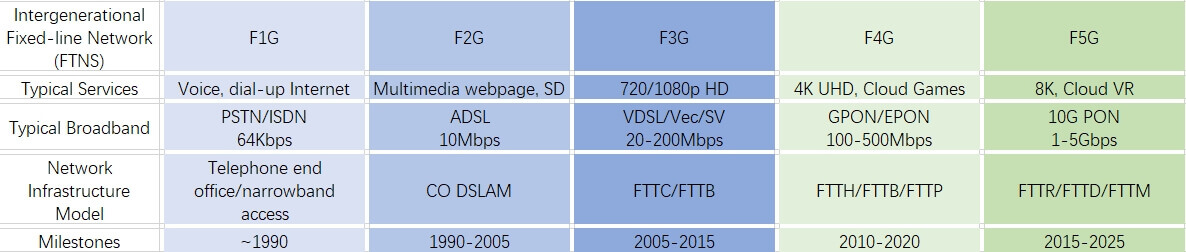
That’s not all. In previous years, PONs were mainly found in carriers’ networks, and in recent years, PONs have begun to expand:
- Expansion to large campus LAN, the birth of POL (Passive Optical LAN)
- Expansion to small and microenterprise LAN, the birth of FTTR-B (Fiber to The Room to Business)
- Expansion to the home LAN, the birth of FTTR-H (Fiber to The Room to Home)

Therefore, we can also see that in recent years, the so-called POL, FTTR new network, the core technology or PON. Essentially, it is the advantages of the PON network itself has contributed to the blossoming of the application of the scene. That PON network in the end what are the advantages?
P2MP Network Architecture Is The Biggest Advantage Of PON Networks
P2MP, that is, point-to-multipoint, naturally adapted to the access network in the number of terminals, access to the traffic convergence ratio of the characteristics of the large.
A PON port of the OLT equipment can be hung under a bunch of user terminals (GPON splitting ratio of 1:64, that is, 64 user terminals), access to the number of terminals is quite substantial.

Moreover, it is not difficult to find that the operation of the network is extremely efficient and resource-saving.
An OLT can efficiently serve up to 64 ONU terminal access devices through a single PON module.
The shared use of backbone fiber greatly reduces the number of required fibers, saving a large number of fiber optic resources.
The network architecture on the OLT and ONU two-tier architecture, flat, the network topology appears to be extraordinarily simple.
Passive Features Can Save A Lot Of Investment And Post Maintenance Costs
The ODN network between OLTs and ONUs is passive and does not contain any active devices, which reduces power requirements and maintenance costs and improves network reliability. The most important device in this is the passive splitter, and it is the presence of the passive splitter that can also accomplish the first advantage mentioned above.

Although the ODN construction cycle is long, the investment cost is large, but it has a long life cycle, generally 15-20 years, or even longer, late each generation of new PON technology are considered forward compatible, can be shared ODN, which will also further extend the service life of the ODN, reduce investment costs.
It is precisely because of the passive splitter device that experts have developed the P2MP’s PON network, which sends data in the downstream by broadcasting, and realizes the access of multiple ONUs in the upstream by TDMA. If not for the invention of the passive splitter, the PON network could not be so efficient and simple.
ONUs Can Be Colocated By OLTs
The PON network can be viewed as a whole, and the OLT can manage and maintain the downlinked ONUs through messages such as PLOAM and OMCI, such as registration, ranging, bandwidth allocation, configuration downlinking, and so on, so generally we only need to add the OLT to the uplink.
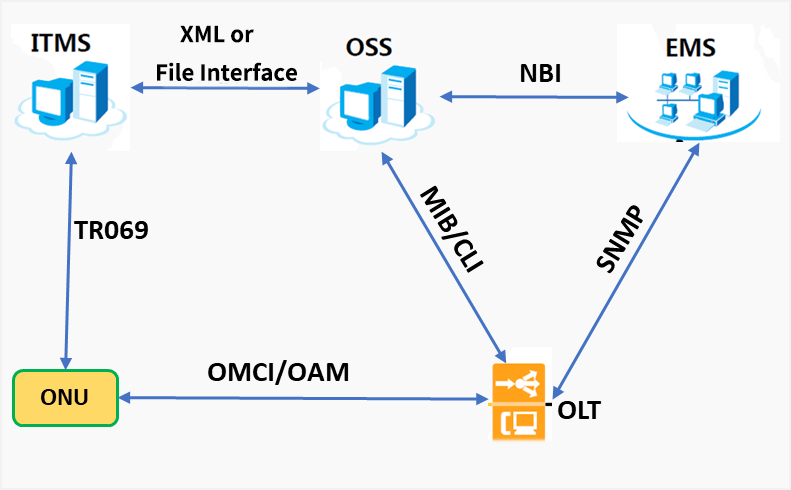
The ONU, on the other hand, can be managed through OLT escrow, and then we can also realize the management of the remote ONU.
One network, one management plane for convenience.
Mature PON Network Technology And Experienced Maintenance
PON technology plays an important role in operators’ fixed access networks, and its wide coverage makes it a huge network system, which can be regarded as a super network.
In China, the three major carriers have adopted PON networks, and traditional DSL networks are gradually being phased out, while PON networks are also seen as a mainstream trend among major carriers, broadband network service providers and contractors in various countries.
After more than ten years of development, PON technology in the fixed access network has occupied a dominant position, a unity is more than ten years, all the bugs, all the inherent shortcomings and all the technical defects, has long been corrected and optimized by the operators. Therefore, the current PON technology and related products have been a long time after the test precipitation, become more mature and perfect, has been quite perfect.
Concluding Remarks
It is due to the validation and success of PON technology in the market that it started to expand to other verticals such as POL, FTTR, etc.
At the same time, with rich experience in PON network construction and maintenance, PON technology has demonstrated rapid scalability when expanding to new scenarios such as POL and FTTR.
Overall, PON networks dominate the access network by virtue of its unique technological advantages. With the development of all-optical networks, traditional switching and routing equipment manufacturers have also begun to invest in the research and development of PON products, and actively expand the PON market, which reflects the industry’s high degree of recognition of PON technology.
There is no doubt that PON technology will continue to evolve and upgrade, PON networks can continue to be green and durable.