
In the article How New Optical Splitters Can Exponentially Increase Access to Combo Ports, we introduced the current status of resource utilization of Combo ports and the principle of capacity-multiplying optical splitters (hereinafter referred to as: new optical splitters). In the following section, we will discuss how to use the new type of optical splitter and the effect of using it.
How To Use The New Optical Splitter
The new optical splitter can be used for both secondary and primary splitting.
When the new type of optical splitter is used for secondary splitting, take an ordinary 1×4 splitter as an example, it is only necessary to replace the original optical splitter in the distribution box with a 4+4 type of optical splitter, insert the pigtail fiber of the GPON user in the original splitter port to the GPON output port of the new type of optical splitter, and the pigtail fiber of the XG-PON user is inserted to the XG-PON output port of the new type of optical splitter, as shown in Fig 1. After capacity expansion, there are still 4 spare ports in the new type optical splitter to install users.
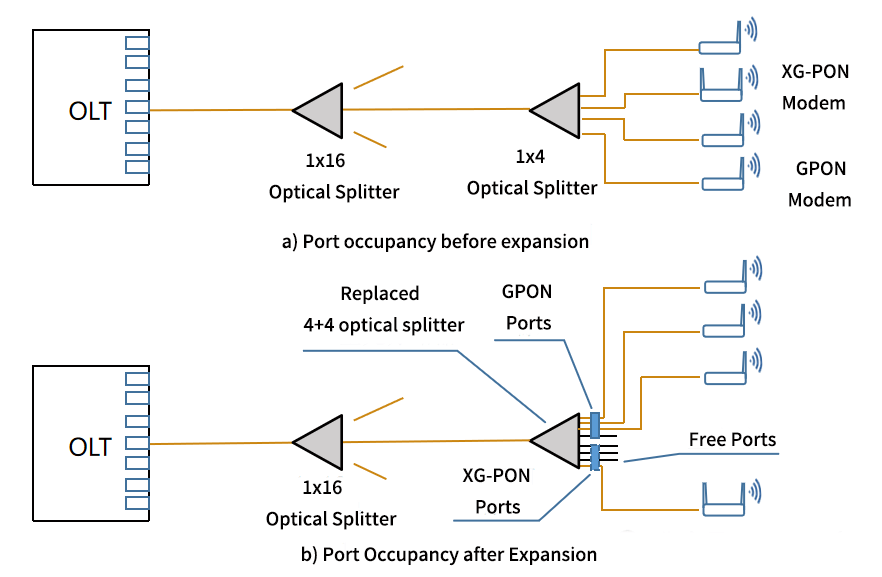
When the new optical splitter is used for primary splitting, take the ordinary 1 × 64 optical splitter as an example, it is only necessary to replace the 1 × 64 optical splitter with a 64 + 64 type optical splitter.
Although the average number of users installed in the Combo port in the primary split scenario is nearly double that of the secondary split, the bandwidth utilization is still very low, and the bandwidth utilization threshold (usually 70%) can still be met within a few years after replacing it with a new type of optical splitter.
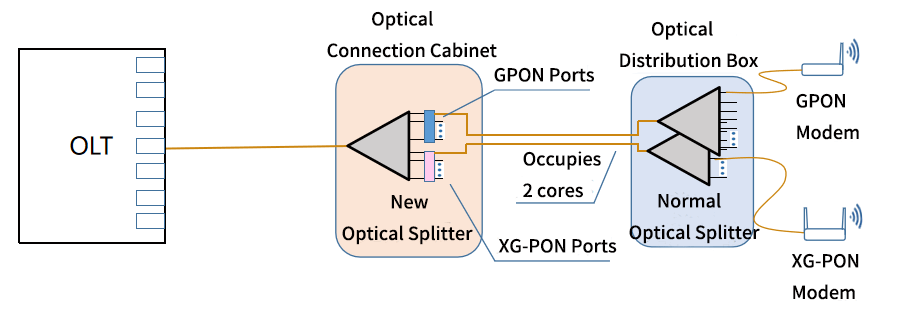
When the ODN adopts two-level splitting, the new optical splitter can also be set in the wiring optical intersection, at this time the distribution box needs to install two ordinary optical splitters of the same type, from the optical connection cabinet to the fiber optic distribution box needs to take up 2 cores of fiber optic cable, as shown in Fig 2.
In the wiring optical intersection to the distribution box section configured with more fiber optic cable cores (3 cores and above) in the metropolitan area network, this scheme can be adoptable.
Cost Per Port Analysis
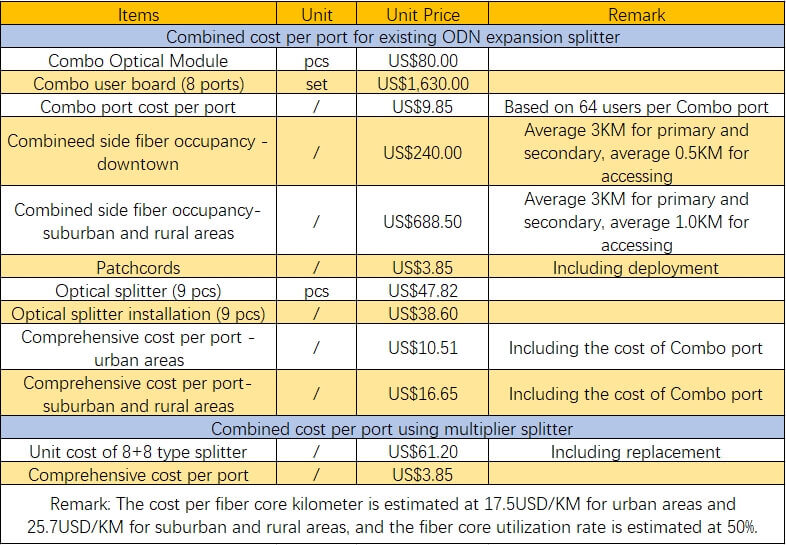
New optical splitter due to the internal increase in the combined splitter, making the new optical splitter unit price is several times higher than the same capacity of the ordinary optical splitter. For example, the unit price of a 1×16 optical splitter is only about 8USD, while the unit price of an 8+8 capacity multiplier optical splitter is as high as 54USD.
However, the use of the new optical splitter, up to Combo port, the combined side of the fiber optic access to double the number of users, thus saving the Combo port and fiber optic cable investment.
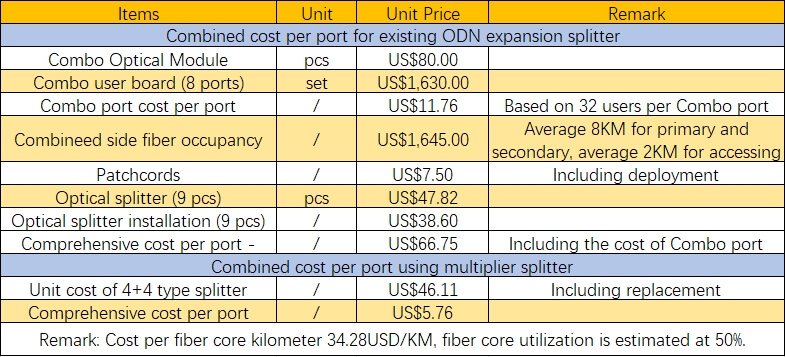
With the new optical splitter under the two-level splitter set up in the fiber optic cable distribution box according to the cost per port, compared with conventional expansion splitter, the use of the new optical splitter in the urban area per port cost is only about 1/3 of the original program, the suburbs and rural areas in general is only about 1/5 of the original program. The cost comparison of the two options for urban, suburban and general rural areas is shown in Table 1.
In remote rural areas, due to the smaller number of users accessed by the Combo port, the length of the fiber on the merging side is longer, which makes the cost per port of using the new optical splitter in remote rural areas relatively lower, or even less than 1/10 of the original scheme. The cost comparison of the two schemes in remote rural areas is shown in Table 2.
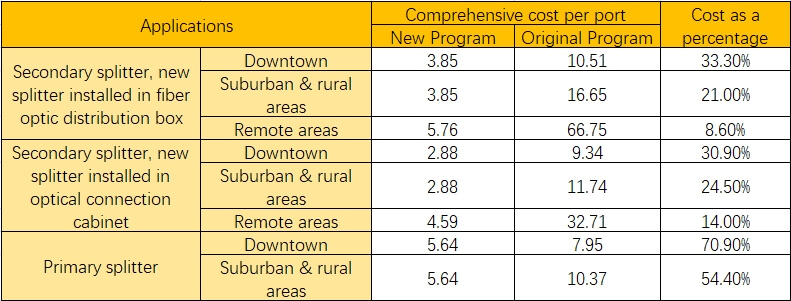
Using the same approach, the per-port cost of the new optical splitter installed in the wiring optical intersection under secondary splitting and primary splitting can be estimated. A comparison of the cost per port for the two scenarios in different scenarios is shown in Table 3.
Construction Timeliness Analysis
When the port expansion of fixed broadband adopts the conventional way, it is necessary to carry out resource survey and verify the uplink resources before expansion, and it is also necessary to build a new primary splitter and the related primary and secondary link cables if the primary splitter ports do not meet the requirements, and it is necessary to synchronize the resource entry, and it takes 6 days for the minimum expansion time in this scenario regardless of the size of the expansion, and it usually takes 7 days to expand the ODN in the range of a wiring optical interconnection. It usually takes 7 days to expand an ODN in the range of wiring optical intersection ~ 15 days.
When the new splitter is used for capacity expansion, no resource survey is required, and the original resource information can be adjusted to open quickly, and the fastest opening time can be completed within 1 day, and the expansion of a wiring and optical intersection range usually takes only 1 day to 2 days, which can meet the broadband market’s requirements for timeliness.
Insertion Loss Testing of New Optical Splitters
Since the downlink of the Combo optical module contains two wavelengths, 1490nm and 1577nm, when the downlink optical power of the PON is tested with an ordinary optical power meter in the ODN link, the test result is the sum of the optical power of the two wavelengths, which is about 3.0dB more than the optical power of a single wavelength.
When an ordinary optical splitter is used for the ODN link, there are two downlink wavelengths at the output port of the splitter, and after replacing the ordinary optical splitter with the new type of optical splitter, there is only one downlink wavelength at the output port of the splitter, so when the insertion loss of the new type of optical splitter is tested with an ordinary optical power meter after the replacement of the optical splitter, there is a situation in which the insertion loss is larger than the normal value by 3.0 dB.
Therefore, the insertion loss of the new optical splitter will have an error of about 3.0dB when tested with an ordinary optical power meter, and it is recommended that the received optical power of the optical cat in the network management be used for testing.
The insertion loss of a capacity-multiplying optical splitter is only about 0.5 dB higher than that of an ordinary optical splitter. For example, the insertion loss of an 8+8 type optical splitter is only about 0.5 dB higher than that of an ordinary 1×8 optical splitter.
Concluding Remarks
In recent years, fixed Gigabit services of operators have achieved great development, but the number of subscribers accessed per PON port and the bandwidth utilization of Combo port is still very low.
The new optical splitter realizes user number multiplication by separating GPON and XG-PON channels in ODN at the user side. Compared with the traditional splitter, the new optical splitter has a higher unit price, but lower cost per port, which has significant cost advantages in urban, suburban and rural areas; it does not require new fiber optic cable lines, so it is more convenient to expand capacity.
In addition, the insertion loss of the new optical splitter is only slightly higher than that of the traditional splitter, which will not affect the network performance and is very suitable for the expansion of existing Combo port users.
Comparatively speaking, in the urban area, ODN with primary splitting, the average number of users of Combo port is high, and the investment saved by expanding the capacity with new type of optical splitter is limited, and it is not recommended to expand the capacity with new type of optical splitter.
While the use of secondary split ODN, especially the current total split ratio of 1:32 Combo port, the new optical splitter expansion can save considerable investment, the application of new optical splitter is very worth promoting.