

At present, compared with overhead optical cables in the suburbs, urban optical cables are mainly laid through underground communication pipelines.
Communication pipelines are generally composed of pipe groups buried under the surface and manholes (handholes) at both ends of the pipe groups, as shown in Figure.
The pipe group is usually composed of one or more plastic pipes. Pipelines are divided into manholes and handholes according to their size; manholes are larger in size, and the internal dimensions are usually not less than 2.2 meters × 1.4 meters × 1.8 meters (length × width × height), and construction workers can construct in the manholes; handholes are smaller in size, and the maximum size is usually no more than 1.7 meters × 1.2 meters × 1.4 meters.

According to different construction scenarios, pipelines are usually divided into long-distance pipelines, municipal road pipelines and station network pipelines. They have certain differences in manhole models, pipe group combinations, burial depths and section lengths.
Long Distance Communication Pipeline
Long-distance pipelines are usually built outdoors, mainly as underground channels for long-distance (TIER 1, TIER 2) optical cables or local network city-county optical cables.
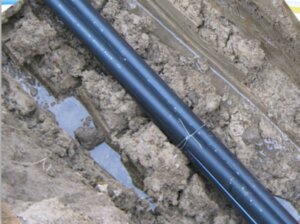
The pipes of the pipelines are mostly 40/33 silicon core plastic pipes, as shown in the figure below. The length of the pipeline should be 960 meters to 980 meters, and the optical cable is laid in the pipeline by air blown method.
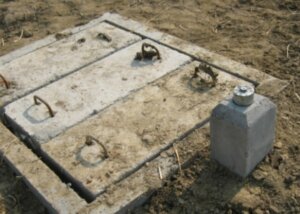
In the early days, long-distance pipelines were often built in farmland. In order not to affect the cultivation of crops above the pipeline, the buried depth of the long-distance pipeline (from the top of the pipe group to the ground) is usually not less than 1.0 meter (slightly different in different sections and soil types), and the handholes are usually buried, with the handhole cover plate not less than 0.6 meters from the ground surface, as shown in the figure below.
Obviously, it is very inconvenient to repeatedly open the buried handhole.

The internal dimensions of the long-distance pipeline manhole are shown in Table 1.
The manhole cover is usually prefabricated with reinforced concrete. When the manhole is built in a location that does not affect crop cultivation, the manhole can be of ordinary type, and the manhole cover is directly exposed to the ground, as shown in Figure.

Long-distance pipelines built in recent years are mainly built along traffic trunk lines.
When built on the shoulders of national and provincial roads, the buried depth of the pipeline is usually not less than 0.7 meters. When built in the isolation zone of expressways and high-speed railways, the buried depth is usually not less than 0.5 meters.
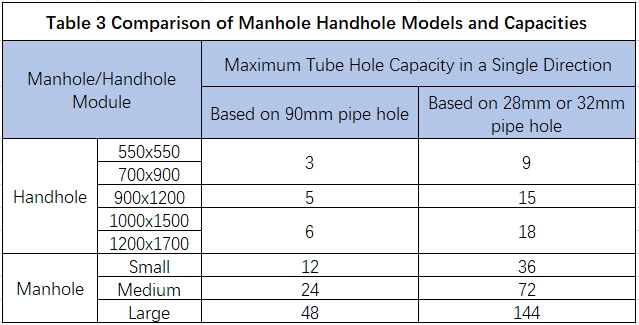
The handholes generally use the ordinary handholes in Figure 4, or the 700×900 handholes in Table 3. When the 700×900 handholes are used for long-distance pipelines built in the field, anti-theft manhole covers are generally used.
In some places, the long-distance pipeline section built on the shoulders of national and provincial roads is constructed according to the section length requirements of municipal road pipelines. This will result in the optical cable not being laid by air blowing way, reducing the laying efficiency of the optical cable. After entering the urban area, the long-distance pipeline is connected to the municipal road pipeline.
Municipal Road Communication Pipeline
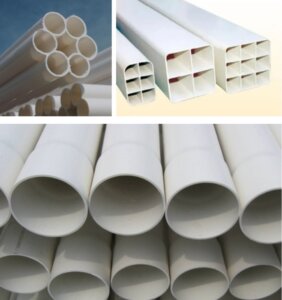
Municipal road pipelines refer to pipelines built along urban trunk roads and branch roads. The pipes are mainly 110/100 solid wall pipes, 7-hole plum blossom pipes (inner diameter 32mm) and/or grid pipes (4 holes/9 holes), as shown in Figure 5. The material of the pipes is mainly PVC-U.
The length of the pipeline section is determined according to the distribution of users along the pipeline and the location of the branch pipeline, generally about 100 meters, and no more than 200 meters.
The minimum buried depth of the pipeline (from the top of the pipe group to the ground) is shown in Table 2.

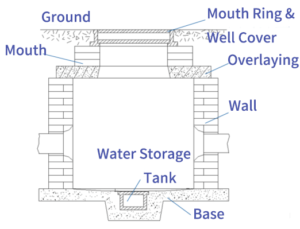
The structure of a manhole (handhole) in a pipeline mainly includes: a foundation (including a water storage tank), a wall, an overlying structure, a mouth (also called a “well neck”), a mouth ring and a well cover, as shown in Figure. The well cover is usually round.
The specifications of manholes (handholes) are related to the capacity of the pipe group. GB 50373-2019 provides recommendations on the specifications of commonly used manholes (handholes) and applicable pipe group capacities, as shown in Table 3.
However, in actual projects, the specifications of manholes are often lower than those recommended by the specifications. This also leads to the manholes being always filled with optical cables, as shown in the figure below.

The wall of the manhole (handhole) is mainly built with bricks, but the construction period of the manhole (handhole) is relatively long, and the quality of the manhole (handhole) is difficult to guarantee.
Therefore, in recent years, the use of prefabricated manholes (handholes) has become more and more widespread.
At present, integrated pipe corridorshave begun to be built on new roads in some cities to replace underground pipelines for various purposes.
However, the current construction and maintenance costs of integrated pipe corridors are much higher than traditional pipelines. Pipelines will remain the main channel for laying optical cables on municipal roads for a long time.

Residential Network Communication Pipeline
The resident network pipeline is the pipeline outside the municipal planning red line, mainly including the communication pipelines in buildings, residences and other areas within the building planning red line.
The resident network pipeline often crosses with gas, water supply/sewage pipelines more frequently, so the pipes are mostly plastic solid wall pipes, plum blossom pipes and silicon core pipes with good bending performance.
The buried depth requirements of the resident network pipeline are shown in Table 2, but it is very common for the actual buried depth of the pipeline to be lower than the standard.
The number of holes in the resident network duct is usually small, and generally only hand holes are built. The resident network optical cable often has more branches, and accordingly, the density of hand holes is also high.

According to YD/T 5178-2017, the handholes of the resident network pipes should be the same as those in the municipal road pipes, and should adopt the handholes in Table 3.
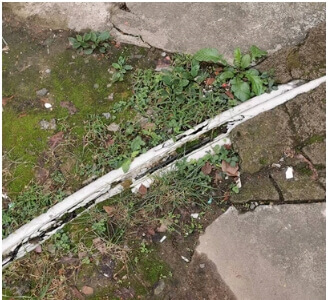
However, in actual projects, SK series wiring handholes are still widely used. The SK series wiring handholes are shallow in depth and low in strength. In actual use, they are more likely to be damaged, as shown in Figure. They are no longer recommended in YD/T 5178.

In Summary
As the urbanization rate increases, the proportion of optical cables laid through pipelines is also gradually increasing.
However, the poor quality of pipeline construction has had a great impact on the laying and maintenance of optical cables. We hope that in the near future, quality of newly built pipelines is qualified.
By providing small diameter microduct cable, and underground fiber optical cable, Bonelinks may help to improve the network connectivity and cost down project investment. Drop us a message at bonelinks.com if we may do something.