

Although about 60% of the quality problems of home broadband services occur in the home network (see the article “Analysis Of Major Quality Problems And Causes Of Home Broadband Networks?”), all home broadband service quality problems are caused by the operators‘ network quality in the eyes of users, and users have thus formed an inherent impression of the quality of different operators’ home broadband services.
In terms of end-to-end connectivity relationships, a carrier’s home broadband network consists primarily of a broadband fiber access network, xxNET, transport network, and content sources, as shown in the figure below.

The transport network mainly provides the connection between the network elements of xxNET, and IDC and CDN belong to the content sources. In recent years, as operators have increased the introduction of content sources, content sources are no longer the main aspect of home broadband networks that affects service quality. The quality problems of home broadband services mainly occur in broadband fiber access networks.
The impact of broadband fiber access networks on the quality of home broadband services is often associated with ODN fiber link outages, ONU weak light, GPON access to Gigabit subscribers, OLT uplink bandwidth limitation, and OLT reloading.
ODN Fiber Optic Link Outages
In terms of the reasons for user complaints about the quality of home broadband services, ODN fiber link outages accounted for more than 70% of the complaints.
Fiber optic cable interruptions due to municipal road reconstruction and residential subdivision reconstruction are the main causes of fiber optic link interruptions, followed by link interruptions due to fiber optical connections. Fiber optic cable interruptions caused by municipal construction are difficult to prevent, and efforts can only be made to shorten the timeframe for emergency repairs.
Link interruptions due to fiber optic connections are often related to the quality of the fiber optic connector. Collective purchasing has made the product cheaper and cheaper, but maintenance costs due to product quality issues are increasing.
However, complaints due to the interruption of the ODN fiber link were eliminated after the fault was repaired and users were dissatisfied with the quality of their home broadband, and it was the lagging and slowness felt by users when using the network that was the main aspect affecting user satisfaction.
ONU Weak Light
ONU weak light (ONU received optical power less than -27 dBm) increases the probability of ONU failure significantly.
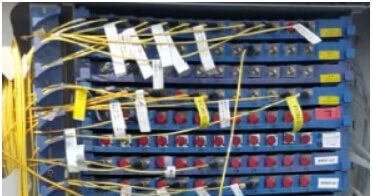
The main cause of weak light in ONUs is excessive macrobend loss in the fiber. The second reason is the high attenuation of the optical connections.The excessive number of optical connections in the ODN link (more than 8) and the end face contamination caused by unused optical connectors without dust caps (as shown in below Figure) can lead to an increase in the attenuation of the connections of the link.
The weak light occurs mainly on the ONU side, and if it occurs on the OLT side, it may be due to the use of Class B+ optical modules in the OLT (Class B+ optical modules have a downstream optical power budget that is 1.5 dB lower than that of Class C+, but an upstream optical power budget that is 4.0 dB lower than that of Class C+).
GPON Access For Gigabit Users
The question of whether GPON can access gigabit users has been controversial. It is generally believed that the number of gigabit users accessed by GPON ports should be strictly controlled, and the specific number of users required varies from place to place, usually from 2 to 5.
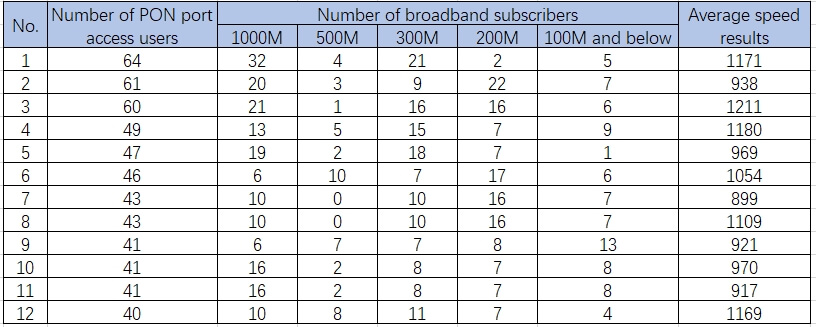
However, according to the results of jsCM’s speed measurement for high-utilization PON port gigabit users during the 2022 Lantern Festival party, as shown in the table below, GPON can fully meet the demand for gigabit development.
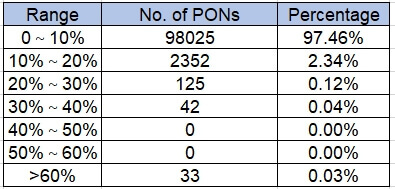
The actual bandwidth utilization of established GPON ports is very low, for example, in a first-tier city J, the percentage of GPON ports with peak downstream bandwidth utilization (in seconds, within a one-week interval) higher than 20% is less than 0.3%, as shown in the table below.
The average Internet speed of Gigabit users is not significantly higher than that of ordinary users, so even if multiple Gigabit users are accessed under the GPON port, the speed measurement of individual Gigabit users is very good.
However, user traffic is often bursty, and the millisecond network speed peak of a single user is always close to the user’s bandwidth. For example, the burst rate of IPTV, 4K/8K and other video-type services at different time granularity is shown in the figure below.
When Gigabit users use the network on a daily basis, although the average network speed is not high (usually several megabytes to tens of megabytes per second), the peak millisecond network speed will still reach the contracted bandwidth limit (the limit of contracted bandwidth is usually set at 100% to 120% of the contracted bandwidth).
Therefore, even if the number of Gigabit users accessed under the GPON port is only two, as long as one Gigabit user is performing speed tests while the other Gigabit user is using IPTV, it may cause millisecond packet loss.
Although millisecond packet loss has a limited impact on the network and the probability of occurrence is not high, if the number of gigabit users accessed under the GPON port is high, the probability of packet loss increases, which brings about an impact on the network usage of other users under the same PON port.
OLT Uplink Bandwidth Limitation
Currently, the bandwidth of OLT uplink circuits is mainly 10GE (two or four, half primary and half backup), and a 10GE circuit expansion threshold of 70% is appropriate.
There is a large gap between the peak rates of services at different time granularities (1ms, 10ms, 100ms, 1s), and this gap becomes more significant the larger the difference between the user’s bandwidth and the user’s average network speed. For example, the millisecond peak of a single gigabit user may be more than 900 Mbps higher than the second peak.
The cache of the OLT is only at the millisecond level, which may cause packet loss when the millisecond peak of the OLT uplink circuit exceeds the circuit bandwidth, so the bandwidth of the OLT uplink circuit should be redundant to a certain extent according to the maximum bandwidth of a single user based on the satisfaction of the second-level peak.
If the expansion threshold for 10GE circuits is 70%, when the circuit utilization is close to the threshold, the millisecond, 10-millisecond, and 100-millisecond levels of bursty traffic may drop packets.
Therefore, it is recommended that the expansion threshold for 10GE circuits should be lower than 60%.
There are still a small number of GE circuits in the existing OLT uplinks, and when there are Gigabit users under the OLT, the GE circuits are obviously not suitable for use as OLT uplinks.
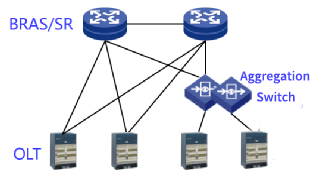
Moreover, when the GE circuits in the OLT uplink are interfaced with BRAS/SR, they are generally aggregated through Layer 3 switches, as shown in the figure below, which also increases the service latency.
OLT Reloading
The number of subscribers accessed by an OLT exceeding 5000 is usually referred to as OLT reloading. OLT reloading is also considered to be one of the most important reasons for affecting the quality of home broadband.
Based on the calculation that each OLT has 16 user boards, each user board has 16 PON ports, and each PON port can access 64 users, the maximum access capacity of the OLT is 16,384 households, and 5,000 households is only 30.5% of the device’s access capacity. If the OLT is overloaded when the number of users exceeds 5,000, then there must be a problem with the performance of the device.
According to the analysis of the number of OLT access users and the percentage of IPTV stuttering/fluttering, as shown in the table below, it can be seen that there is a certain correlation between the number of OLT access users and user experience.
However, this correlation may also be related to the restricted OLT uplink bandwidth, when the OLT uplink bandwidth is unchanged, the more the number of users accessed by the OLT, the worse the user experience is naturally.
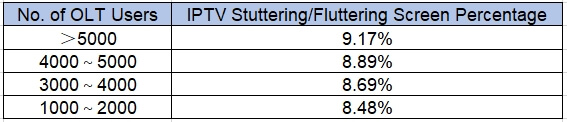
The impact of OLT reloading on users’ Internet experience is not obvious. Based on the pressure of assessment, in order to prevent a single OLT failure from affecting too large an area, it may be the main reason for setting a limit on the number of users accessed by a single OLT.
Put At The End
Due to the different network status, the above factors have different impacts on home broadband quality in different metropolitan area networks. The existing PON network management has limited ability to analyze service data packet loss.
The above analysis of the impact of Gigabit user burst traffic on home broadband quality is only based on subjective judgment. We also hope to get feedback from operation and maintenance personnel on the actual situation of the network.