

G.657 optical fiber is also known as bending loss insensitive optical fiber. The optical cable that is thinner than ordinary telephone lines used to connect FTTH uses G.657 optical fiber. Without G.657 optical fiber, there would be no large-scale application of FTTH. G.657 optical fiber is divided into multiple subcategories, and the most commonly used one is G.657A2.
G.652 optical fiber is the most widely used optical fiber in metropolitan area networks. In addition to FTTH home optical cables, other communication optical cables in metropolitan areas are basically G.652 optical fibers. G.652 optical fibers are divided into 4 subcategories, and G.652D is currently the most commonly used.
Compared with G.652D optical fiber, how strong is the bending resistance of G.657A2 optical fiber?
The Minimum Bending Radius of G.657 and G.652 Optical Fibers in the Standards
In the relevant standards, the minimum bending radius of G.657A2 fiber is recommended to be 7.5mm, while the minimum bending radius of G.652 fiber is required to be no less than 30mm, but the meanings of the minimum bending radius of the two are completely different.
The minimum bending radius of G.657A2 fiber means that the additional loss measured at 1550nm/1625nm does not exceed 0.5dB/1.0dB respectively when the fiber is loosely wound with a radius of 7.5mm.
The minimum bending radius of G.652D fiber means that the additional loss measured at 1625nm does not exceed 0.1dB when the fiber is loosely wound with a radius of 30mm for 100 turns.
The additional loss caused by bending an optical fiber with a bending radius much larger than its diameter is called macro bending loss. The macro bending characteristics of G.657A2 fiber and G.652D fiber are shown in the table below.
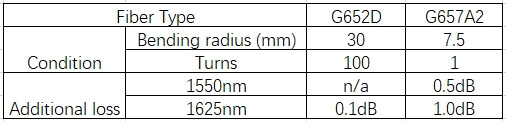
Obviously, the minimum bending radius of G.657A2 fiber and G.652D fiber are not comparable.
Test of the Bending Resistance of G.657 and G.652 Optical Fibers
When installing the FTTH optical cable, in order to facilitate the termination of the optical cable, the installation and maintenance personnel often fuse a small piece of pigtail to the FTTH optical cable at the distribution box and ONT (commonly known as “optical modem”), as shown in the figure below.
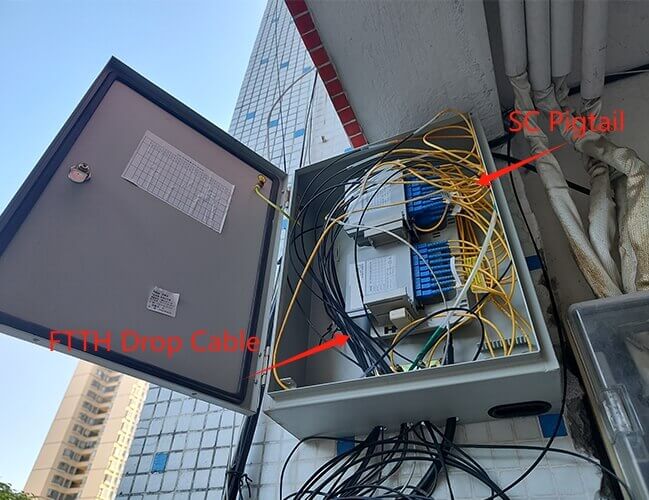
In the figure, the optical fiber type in the pigtail is G.652D, and the optical cable type in the FTTH home optical cable is G.657A2.
Because the laying environment of the pigtail and the drop optical cable is the same and the size is similar (the diameter of the pigtail is 2.0mm, and the short axis/long axis diameter of the drop optical cable is 2.0mm*3.0mm), it is more practical to compare the bending resistance of the pigtail and the drop optical cable, and it can basically reflect the difference in the bending resistance of G.652D and G.657A2 optical fibers.
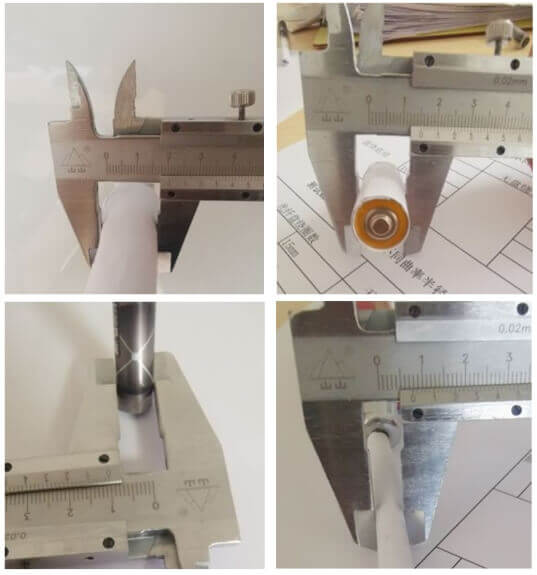
Since the macro bending loss of optical fiber in ODN is mainly affected by the downstream wavelength (see the article “The Impact of Insufficient Fiber Bending Radius on ODN Link Attenuation”), only the additional loss of the pigtail and the access optical cable at a wavelength of 1490nm with different radii was tested. Some of the tested molds are shown in the figure below.
The test results are shown in the table below.
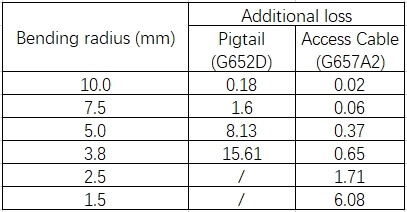
From the test results, it can be seen that the bending resistance of the home optical cable (G.657A2) is far better than that of the pigtail (G.652D), especially under small bending radius, the bending resistance of the home optical cable is even better.
Conclusion and Recommendations
Since there is a huge difference in the bending resistance of G.657 and G.652 optical fibers, and the pigtail itself is relatively soft, it is very easy to produce bends with a very small radius.
According to the statistics of installation and maintenance failures in a metropolitan area network, the proportion of installation and maintenance failures caused by insufficient bending radius of pigtails is as high as 50%. Therefore, it is not advisable to use pigtails to terminate the home optical cable during FTTH installation. Pre-terminated drop cables (as shown in the figure below) should be used for installation and termination to reduce the additional loss caused by excessive bending of the optical cable.
If you encounter any problems in fixed network construction, please leave us a message at www.bonelinks.com and we will provide you with technical support.