

How to use limited underground pipeline resources to lay new optical cables is one of the backbone network construction problems faced by network operators and contractors today.
Because the pipe hole resources of underground communication pipelines are the communication basic resources that are in short supply for operators, except for newly built roads and development zone roads, the pipe hole occupancy rate of other roads is generally high.
Due to construction conditions, it is extremely difficult to expand the capacity of the pipe hole of communication pipelines, and the current situation of shortage of underground pipe hole resources of operators cannot be improved for a long time.
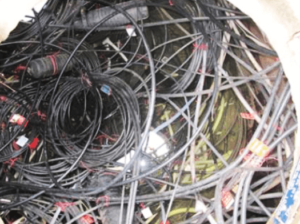
The “hole occupancy rate” indicator is usually used to measure the usage of hole resources in a certain pipeline section. The “hole occupancy rate” is the ratio of the “number of sub-holes occupied by optical cables” to the “number of sub-holes converted from the pipe group”.
Usually, each sub-tube of a porous pipe is counted as 1 sub-hole, and a large-diameter single-hole pipe is converted according to the number of sub-holes of a porous pipe with a similar outer diameter.
At present, the occupancy rate of pipe holes on many roads exceeds 90%, and some sections even reach 100%. It is difficult to add new optical cables to the existing pipe holes, and it is urgent to reduce the occupancy rate of the existing pipe holes. The following are some methods to reduce the occupancy rate of pipe holes.
Use Textile Sub-tube
The pipe group combination of underground communication pipelines generally includes some single-hole pipes with an inner diameter of about 100mm or 90mm.
According to the requirements of the “Communication Line Engineering Design Specifications”, when laying optical cables in single-hole pipes, multiple plastic sub-pipes should be laid to improve the utilization rate of the pipe holes. In a single-hole pipe with an inner diameter of 100mm, 4 sub-pipes of 32mm/28mm specifications are usually laid, and an optical cable is laid in each sub-pipe. In this way, 4 optical cables can be laid in a single-hole pipe with an inner diameter of 100mm.
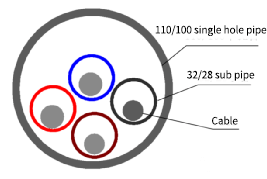
However, in this case, the cross-sectional utilization rate of the single-hole tube (Σ optical cable cross-sectional area/single-hole tube cross-sectional area) is too low, only about 10%.
The textile sub-tube is usually a soft belt-shaped sub-tube made of polyester and nylon mesh, with a low friction coefficient and a traction rope inside. The textile sub-tube that is put in place at one time is called a belt.
Each belt of textile sub-tube has 3 different combinations, one belt with 1 hole, one belt with 2 holes, and one belt with 3 holes, which can respectively put in 1, 2, and 3 optical cables.

The use of textile sub-tubes can increase the number of optical cables laid in each single-hole tube by several times, thereby reducing the hole occupancy rate accordingly.
The tensile strength of the textile sub-tube exceeds 1000kg, which is several times that of ordinary pipeline optical cables. Directly laying or removing optical cables in the pipe holes of existing optical cables can easily cause damage to the optical cables.
If the textile sub-tube is laid first and then the optical cable is passed through the textile sub-tube, it is easier to implement and will not cause damage to the optical cable.
However, the application of textile sub-tubes faces the following problems:
- The price is relatively high; the price of each sub-hole is about USD715/km, which is higher than 32mm/28mm sub-tubes (about USD615/km) and 12mm/10mm micro-tubes (about USD125/km).
- When laying optical cables in single-hole pipes, sub-tubes are often not laid, but cables are directly stacked. In this way, the use of textile sub-tubes cannot increase the number of optical cables that can be carried by the pipe hole. This is also the reason why textile sub-tubes have not been widely used.
Use Microducts and Microcables
Compared with laying ordinary optical cables, under comparable conditions (optical cables are easy to lay, replace and manage), the scheme of manually laying microducts in metropolitan conduits and then blowing micro cables through microducts can reduce the duct hole occupancy rate by nearly 1 times compared with laying ordinary cables.
However, micro cables need to be laid by air blowing, requiring the construction unit to have cable blowing equipment.
In addition, due to the poor mechanical properties of micro cables, their safety is affected to a certain extent in places where people can touch, such as hand holes.

Use Compact Optical Cables
Compact optical cable is a high-density optical cable with mechanical properties that meet the requirements of ordinary optical cables, but with an outer diameter that is much smaller than ordinary optical cables with the same number of cores.
Unlike micro cables, compact optical cables can be laid like ordinary optical cables without having to be placed in specific micro tubes.
For the same type of optical cable, its “minimum allowable tensile force” index is mainly proportional to the cross-sectional area of the optical cable.
In order to achieve the minimum tensile performance of ordinary optical cables, the minimum outer diameter of compact optical cables is usually equivalent to that of ordinary optical cables, about 9.5mm. The minimum number of cores of compact optical cables is usually not less than 96 cores.
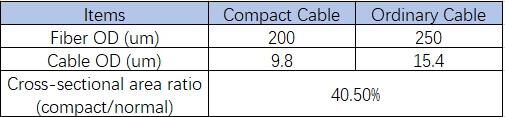
Due to the small cross-sectional area, the use of compact optical cables in single-hole pipes can reduce the pipe hole occupancy rate by more than 50%.
For example, each multi-hole pipe can usually lay about 10 ordinary optical cables of various outer diameters. If compact optical cables are used for large-core optical cables, each multi-hole pipe can lay more than 20 hybrid optical cables of various outer diameters.
Combined Small Core Cables
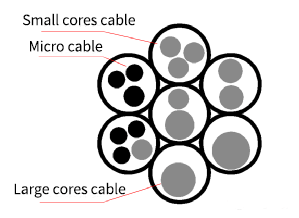
If multiple small core optical cables terminated at the same location (same or adjacent ODF, same optical crossover) and with the same route are at the same optical cable level, they can be merged into a large core optical cable to reduce the occupancy of the pipe hole.
The optical cable level here refers to: core layer, backbone aggregation layer, ordinary aggregation layer, and base station access, trunk section, distribution section, introduction section, etc. at the access layer. Optical cables at different levels can also be merged if the starting point, end point and route are the same.
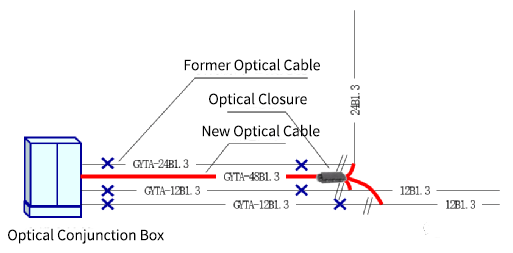
The number of cores of small-core optical cables is relative to the number of cores of newly laid optical cables, and there is no strict requirement for the number of cores.
However, from the perspective of controlling engineering investment, the number of cores of a single optical cable to be removed should not exceed 48 cores.
Among the existing optical cables that have been laid, 24 cores or less account for more than 60%. Even if 10% of them can be merged, it can greatly alleviate the current situation of general shortage of pipe hole resources.
Use the Existing Optical Cable
Although the existing pipe hole occupancy rate is very high, the fiber core utilization rate of the optical cable in use is very low.
For example, the overall fiber core utilization rate of the optical cable (Σ in-use fiber core / Σ in-use optical cable core) of a prefecture-level city of operator M is only 27.7%, while the overall fiber core utilization rate of operator T in the same region exceeds 50%.
Operator M can reduce the laying length of the optical cable by slightly utilizing the spare fiber cores of the existing optical cable, thereby reducing the occupancy of pipe hole resources.
For example, currently, customer access usually directly lays 12 core optical cables from the junction box (or machine room) to customer users. Since each user actually needs only 1 to 2 cores, this leads to a low core utilization rate of the customer access optical cable.
When adding new customer users, if only 2 to 4 cores are allocated to the user, and multiple users share one optical cable, the core utilization rate of the customer access optical cable can be greatly improved.

In the above figure, the numbers in Customer 1 to Customer 5 represent the time sequence of installation of customer users.
In Figure B, when Customer 2 to Customer 5 are being installed, only the optical cable from the junction box to the JiKe users needs to be laid.
Summary and Suggestions
The use of compact optical cables or micro tubes and micro cables for new optical cables can reduce the occupation of the remaining pipe hole resources by optical cables. However, as more and more optical cables are added, if the original optical cables in the pipe group are not sorted out, the pipe group will eventually be occupied.
Therefore, for sections with high pipe hole occupancy rate, before adding optical cables, Bonelinks recommends that the original optical cables should be appropriately reconnected and adjusted to ensure that there are a certain number of free sub-holes in the pipe group after the addition of optical cables in this phase of the project.
For sections where the occupancy rate of the pipe hole reaches 100%, the textile sub-tube can be laid through the gap of the original pipe hole first, and then the compact optical cable with a large core number can be laid from the textile sub-tube.
The existing multiple small-core optical cables can be merged to free up the pipe hole resources before adding new optical cables. If you are experiencing any cabling challenges, feel free to contact us at bonelinks.com and we’ll talk to you about the best way to do it.