

The start of the development of plastic optical fiber for communication (POF for short) is almost the same as that of glass optical fiber, both of which started in the 1960s.
When it comes to the classification of optical fiber for communication, it is relatively easy to think of: multi-mode fiber, single-mode fiber, G.652, G.654, etc. But from the 1970s, the development of glass optical fiber is like a hang-up, while the plastic optical fiber has been difficult to solve because of the problem of attenuation to the point that it is difficult to find its trace in the communication network.
Transmission Characteristics Of Plastic Optical Fiber
Depending on the refractive index distribution of the core, plastic optical fibers are classified into step index (SI) and gradient index (GI) fibers. The refractive index distribution of SI and GI fibers is shown in the figure below.

In SI fiber, different rays of light travel along paths of different lengths, and when they reach the output of the fiber they become discrete in time, with instantaneous delay, which affects the bandwidth.
The refractive index of the core of a GI fiber is variable, and the speed of light transmitted along different paths is also variable. Although the path along the fiber core is the shortest, it has the highest refractive index, so the light travels the slowest; the farther away from the core, the smaller the refractive index, and the faster the light travels there.
By using the transmission speed difference and the transmission optical range difference to completely cancel each other, dispersion can be eliminated, thus increasing the bandwidth of the GI fiber. The transmission of light in SI and GI fibers is shown below.

There are two main core/cladding materials for plastic optical fibers, PMMA (polymethylmethacrylate) and PF-PMMA (fluorinated PMMA).
PMMA commonly known as acrylic, plexiglass, attenuation coefficient, cheap, generally used in SI plastic optical fiber.
PF-PMMA (fluorinated PMMA) has a small attenuation coefficient but is more expensive and is generally used in GI plastic fibers.
The attenuation coefficient of plastic optical fiber is shown below.
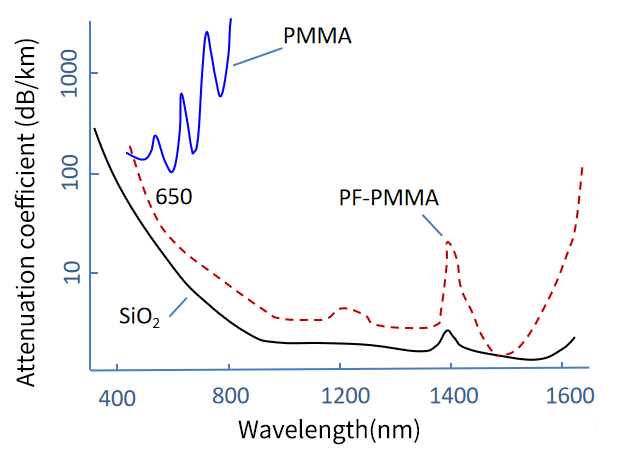
Plastic optical fiber belongs to class A4 multimode fiber, which is divided into several subclasses. The main transmission characteristics of different subclasses of SI plastic optical fiber are shown in Table 1, where the values refer to the typical values of current products.

The main transmission characteristics of different subclasses of GI plastic optical fiber are shown in Table 2. Since GI plastic optical fiber is less used in China, the values in the table are mainly quoted from IEC 60793-2-40:2021, and the mode bandwidths of the actual products are higher than those in Table 2, such as the mode bandwidths of a certain A4h class of products up to 9700Mhz-100m.

Manufacturing Of Plastic Optical Fibers
There are two main ways to manufacture plastic optical fiber, extrusion method and drawing method. SI plastic optical fiber is usually produced by extrusion method and GI plastic optical fiber is mainly produced by drawing method.
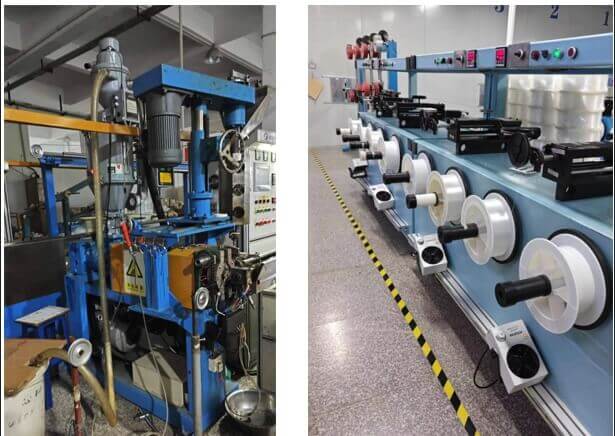
SI Plastic Fiber Extrusion Production Line usually consists of a granule drum, transfer pump, core extruder, cladding extruder and fiber tray, as shown in the figure below.
The production process is that the pellets as the core are put into the granule drum, and then they are injected into the core extruder to extrude the core by using the transfer pump, and then the cladding extruder is used to extrude a cladding on the outside of the formed core, and then it is cooled quickly, and then finally it is made into the SI plastic optical fiber.

At present, the domestic plastic optical fiber manufacturers only have the production capacity of SI plastic optical fiber, which are produced by extrusion method. The picture below shows the extruder and fiber tray of the plastic optical fiber being produced.
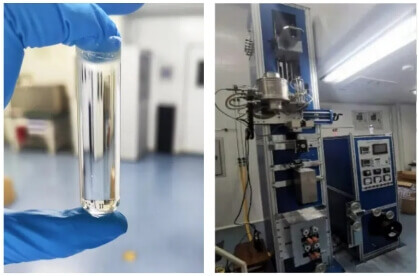
The drawing method requires the use of chemical methods to create the designed refractive index distribution of the large-diameter perform rod, and then the perform rod are placed in a high-temperature furnace, heated to make it soften and drawn to meet the diameter requirements of the fine optical fiber.
The drawing process is just a densification process from thick rod to fine fiber, and the transmission properties of the fiber need to be obtained through the rod-making process. Therefore, GI plastic optical fiber manufacturing difficulties is to create a core refractive index distribution in line with below figure of the perform rod. The process of wire drawing from the preform is shown in the figure below.

In some university laboratories, plastic optical fibers for testing are manufactured by the drawing method.
Application Scenarios Of Plastic Optical Fiber
The advantage of plastic optical fiber is good flexibility and strong bending resistance, therefore, the core diameter of plastic optical fiber can be made larger, so that the coupling between the optical fiber and the light source will be easier.
The figure below shows plastic optical fibers with different core diameters, the transparent part of the fiber in the figure is the core/cladding, and the black sheath is the tight sleeve layer.

At the same time, plastic optical fiber is relatively soft, optical fiber can be truncated with a simple tool, and fiber ends can be completed manually. Figure a below shows the blade for cutting plastic optical fiber, and figure b below shows several plastic optical fiber connectors.

The termination of glass optical fiber is much more troublesome. For example, in the FTTR scenario, the core diameter of the fiber in the indoor cable is only about 10 μm, and the cutting and termination of the indoor cable requires the operator to arrange for special technicians and equip the fiber fusion splicer to complete. If the use of GI plastic fiber, the user’s home fiber optic cabling, cutting, termination and other work can be completed by the user.
With high attenuation and low bandwidth, SI plastic optical fiber is suitable for short-distance communication systems with a transmission distance of not more than 100 meters and a transmission rate of not more than 100 Mbps.
GI plastic fiber has less attenuation and large bandwidth. The mode bandwidth of some models of GI plastic optical fiber is up to 10Gbps-100m, which can support 10Gbps transmission within 100m, and can work at 850nm and 1300nm wavelengths, which can be used in most scenarios as an alternative to OM1, OM2, and OM3 multimode fibers.
Put At The End
Plastic optical fiber attenuation, low bandwidth, easy to become the end of the characteristics of the plastic optical fiber is suitable for short distances, the transmission rate requirements of the scene is not high.
At present, the country only has the production capacity of SI plastic optical fiber, plastic optical fiber is only used in industrial control, automotive multimedia and other low-speed systems.
In FTTR, in-building wiring and other scenarios that require high transmission rates, glass fiber or twisted pair cable is still used as the transmission medium.
If these scenarios use GI plastic fiber, it may be more conducive to user operation and maintenance, and the cost is also lower. But unfortunately, there is no domestic production of GI plastic optical fiber, the international GI plastic optical fiber industry is not perfect, plastic optical fiber in the scale of communication applications also become distant.