

MWDM refers to medium wavelength division multiplexing, which is based on the first 6 wavelengths of CWDM. The center wavelength of each channel is shifted up and down by 3.5nm to form 2 new channels, supporting a total of 12 channels. Since the working wavelength of MWDM is similar to that of CWDM, these wavelengths can meet the requirements of 25G DML optical modules for 10km transmission, thereby increasing the number of 25G fronthaul channels supported by a single optical fiber from 6 channels to 12 channels.

How MWDM Works?
5G-A base stations mainly use passive WDM technology. Based on cost considerations, passive WDM generally uses CWDM (coarse wavelength division multiplexing) and uses lower-priced DML (directly modulated laser) optical modules. The channel rates of base station fronthaul are mainly 10G and 25G.
CWDM supports a total of 18 wavelengths. Since the dispersion coefficient of the commonly used G.652 optical fiber increases with the increase of wavelength, and the dispersion tolerance of the 25G DML optical module is only about 60ps/nm.
Therefore, when the channel rate of the front transmission is 25G, the DML optical module can only use the first 6 wavelengths of the CWDM wavelength (the dispersion of the 6th wavelength transmitting 10km optical fiber link is 60ps/nm), that is, a single optical fiber can only support 6 channels of 25G front transmission.

The optical module used for CWDM usually does not contain TEC (semiconductor cooler). When the operating temperature changes, the transmission wavelength of TOSA (optical transmission assembly) will drift (about 0.1nm/℃).
Since the operating temperature range of the optical module is relatively large (maximum: -40℃~+85℃), the “maximum center wavelength deviation” indicator of CWDM optical module is also as high as ±6.5nm.
If TEC is added to the CWDM optical module, the TOSA of the same wavelength will work at different temperatures, and the wavelength output by the optical module will also be different.
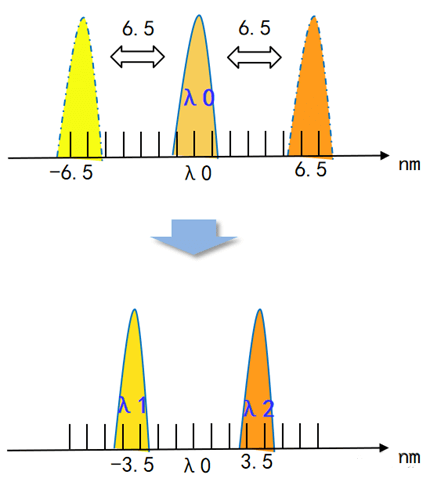
MWDM initially used this method to expand a CWDM optical module with a single wavelength into a MWDM optical module with two wavelengths.
The advantages of this are:
- It can be achieved by simply adding TEC to the CWDM optical module, making full use of the existing CWDM industry chain.
- TEC can make the operating temperature of TOSA more stable, thereby improving the transmission performance of the optical module.
Cost Challenges Facing MWDM
Although the method of generating different wavelengths through TEC temperature control is theoretically feasible, the central wavelength of MWDM is offset by 3.5nm compared with CWDM, and the temperature difference of TEC of adjacent wavelength optical modules of MWDM is as high as nearly 70℃. The range of TEC temperature adjustment is too large, and conventional TEC cannot meet the requirements.
Therefore, MWDM optical modules mainly use TOSA that is consistent with the central wavelength of MWDM.
Since the channel spacing of MWDM is smaller than that of CWDM, in order to reduce the impact of ambient temperature on the output wavelength, even if a TOSA that is consistent with the central wavelength of MWDM is used, TEC is still required for temperature control in the MWDM optical module.
Since the wavelength of the multiplexer/demultiplexer of MWDM is completely inconsistent with that of CWDM, it is impossible to utilize the existing thin film filters in the CWDM industry chain.
Conclusion and Thoughts
The original intention of MWDM was to make full use of the CWDM industry chain to reduce production costs, but judging from the current products, this goal has not been achieved, which also leads to the cost of MWDM being much higher than CWDM.
At present, MWDM is used with semi-active wavelength division, and the optical module supports top adjustment technology.
However, CWDM cannot be used with semi-active wavelength division at present, which makes it difficult to directly compare the prices of MWDM and CWDM, which is conducive to the promotion of MWDM.
The price of electronic products is mainly determined by the scale of production. It is believed that with the increase in the number of operators’ centralized procurement, the price of MWDM will quickly drop to a reasonable level.
As a major manufacturer of WDM splitters, Bonelinks has extensive experience in production, deployment and installation of splitters of different wavelengths, such as MWDM, CWDM and FWDM. If you encounter difficulties in the construction of 5G base stations or CCTV with multiple signal bands, please feel free to contact us for product and technical exchanges.