

Under normal circumstances, the downstream attenuation of the ODN link loss should be about 0.13dB/km lower than the upstream attenuation.
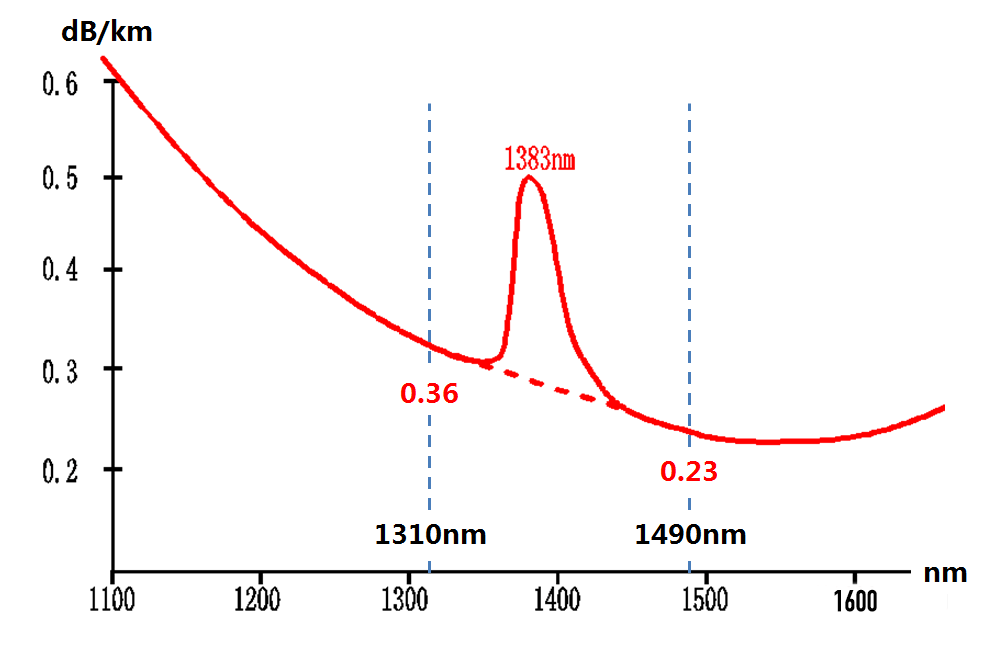
GPON networks use 1490nm/1310nm wavelengths for downstream and upstream, respectively. The main fibers used in ODN (optical distribution network) are G.652D and G.657A2. The attenuation of these two fibers at 1490nm/1310nm wavelengths is 0.23dB/km and 0.36dB/km, respectively, as shown in the figure below.
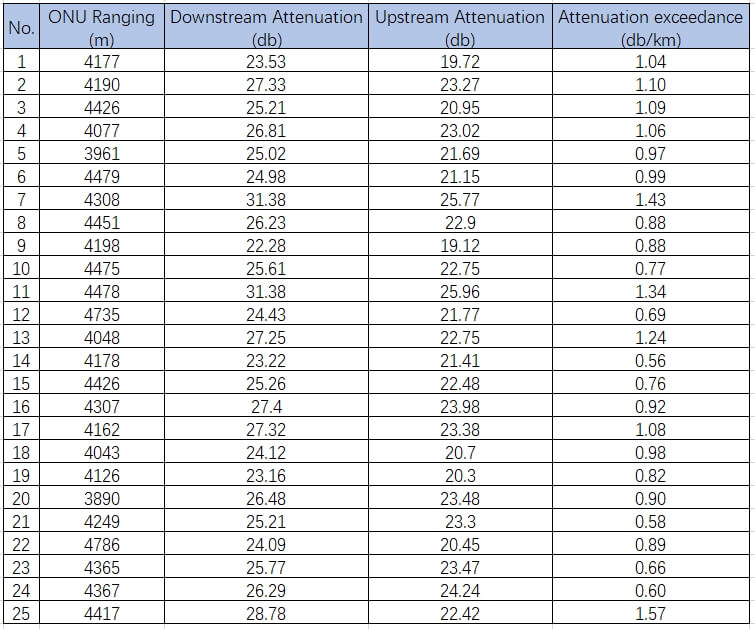
However, when analyzing the downstream/upstream attenuation of a metropolitan area network ODN link, it was found that the downstream attenuation of the ODN links in use actually exceeded the upstream attenuation by 100%, with an average increase of about 0.53dB/km per link. That is, the downstream loss exceeded the normal value by about: 0.53 + 0.13 = 0.66(dB/km). The attenuation of some links is shown in the table below.
ODN Link Loss is More Sensitive to Long Wavelengths
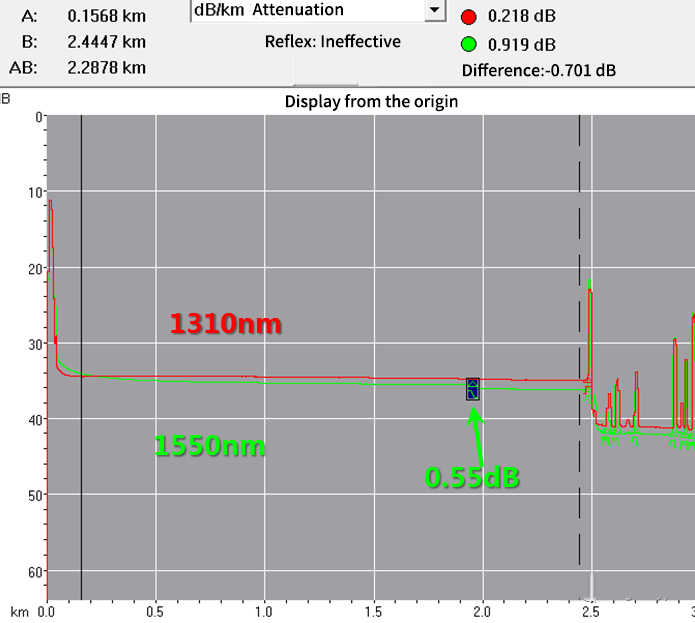
The optical fiber link was tested using the 1550nm/1310nm wavelength of the OTDR (the 1550nm wavelength was used instead because the ODTR used did not have a 1490nm wavelength) and it was found that the attenuation of the 1550nm wavelength at the optical cable joint was significantly greater than that of the 1310nm wavelength, as shown in the figure below.
In a cable section containing multiple connectors, almost all connector losses exhibit the same phenomenon, as shown in the figure below.
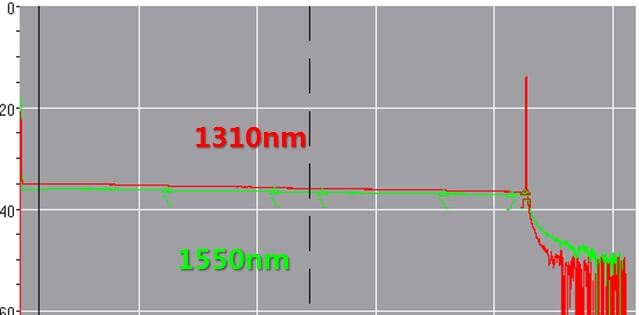
The attenuation of existing ODN links shows obvious wavelength sensitivity, that is, the attenuation is greater at longer wavelengths.
The Fiber Bending Radius at the Abnormal Loss Point is Obviously Insufficient
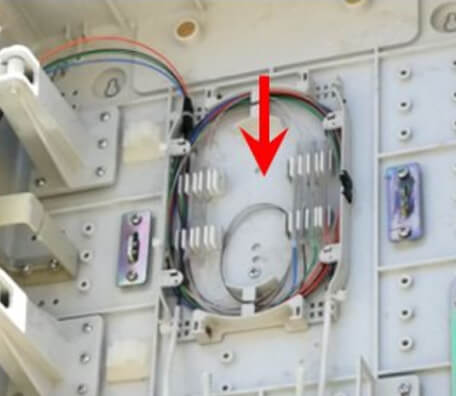
What factors will cause the attenuation of the optical cable joint to be affected by long wavelengths? We know that the macro bending loss of optical fiber is sensitive to long wavelengths. Could it be caused by the insufficient bending radius of the optical fiber? Let’s first look at the winding of the optical fiber in the optical cable joint, as shown in the figure below.

According to the construction and acceptance specifications for communication line projects, the coiling radius of the G.652 optical fiber should be no less than 30mm, but the coiling radius of the optical fiber at the connector is estimated to be only about 15mm (arrow in the figure).
Let’s take a look at the bending radius of the optical fiber at other fiber coils and the end of the optical cable distribution box as shown in the figure below.
The bending conditions of the optical fibers in the straight splicing tray and integrated melting and distribution module of the optical cable junction box are shown in the figure below.

In the entire ODN link, wherever fiber coiling is involved, the fiber bending radius generally does not meet the specification requirements. This is mainly because it is difficult to control the excess length of the fiber during construction.
After the fiber is coiled several times in the splicing tray that meets the standard, some of the remaining length must be coiled in a small circle.
G652D Optical Fiber Additional Loss Test at Small Bending Radius
When the bending radius of the optical fiber is less than the standard value, how much difference is there in the additional loss at different wavelengths? We coiled the G.652D optical fiber onto cylinders of different radii for a specific test. The test site is shown in the figure below.
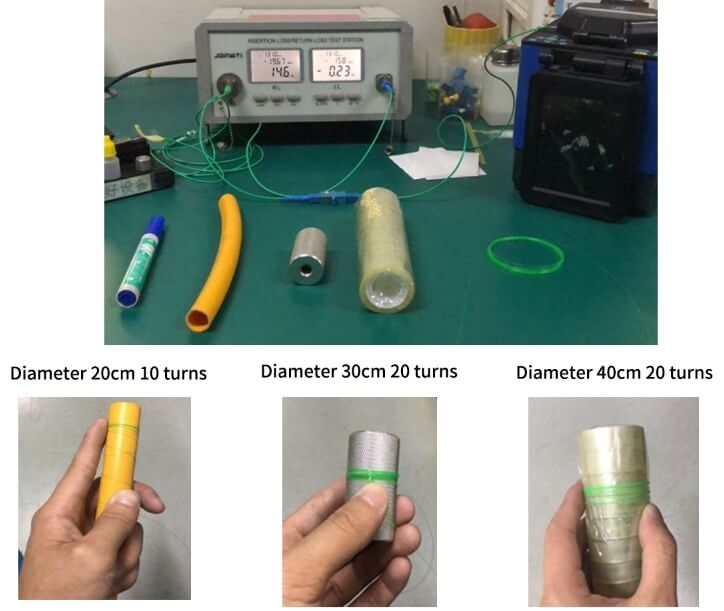
Cylinders with diameters of 40mm, 30mm and 20mm were selected, and the additional loss test results of the optical fiber being coiled 10, 20 and 40 times respectively are shown in the following table.
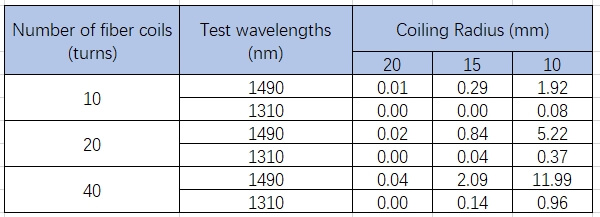
It can be seen from the above table that when the curvature radius of the G.652D optical fiber is less than 15 mm, the additional loss at long wavelengths is more obvious. The smaller the bending radius and the more windings, the greater the additional loss.
Conclusion and Recommendations
Since optical fiber macro bending loss is more sensitive to long wavelengths, when the ODN downlink attenuation significantly exceeds the normal value, it is generally due to the fact that the bending radius of the optical fiber does not meet the specification requirements.
With the application of xG-PON, the downlink of ODN will use a longer wavelength of 1577nm, and the macro bending loss of the optical fiber will be greater. The insufficient bending radius of the optical fiber may restrict the application of xG-PON.
Since it is not easy to coil the excess length of optical fiber to meet the specification requirements at the fiber splicing point, it is difficult to eliminate the problem of insufficient fiber bending radius in low-cost and low-quality access network projects. Therefore, Bonelinks recommends the following:
- When the access network project is completed, the ODN link downlink/uplink must be tested for attenuation using the corresponding wavelengths, and the test results should meet the design requirements.
- Currently, the price of G.657A2 fiber and G.652D fiber is almost the same. All wired access network optical cable lines should use G.657A2 fiber.