

The optical cable distribution frame is the interface device of the trunk optical cable node in the optical fiber access network. After the optical cable is introduced into the optical cable distribution frame, it is fixed, fused, and wired, and then the network connection between the trunk layer and the wiring layer is realized using jumper links.
However, the optical cable distribution frame is usually not directly connected to the user. The user generally connects to the fiber optical distribution box through the entry section optical cable, and then connects to the wiring optical junction through the introduction section optical cable.
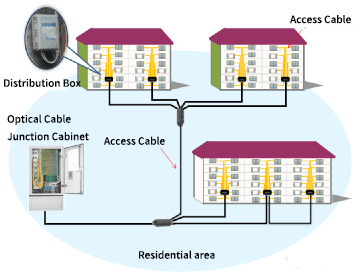
The capacity of the wiring optical cable distribution frame determines the maximum number of cores of the incoming optical cable. Under different splitting methods, the number of fiber cores of the incoming optical cable occupied by a fiber distribution box varies greatly.
Therefore, the coverage capacity of a wiring optical cable distribution frame is determined by the capacity of the wiring optical cable distribution frame and the splitting method.
Scene Using Primary Splitting
According to the national standard, the internal optical fiber access network of residential areas built after April 1, 2013, and public buildings built after March 1, 2021, shall be built by the developer. In this scenario, ODN generally adopts the primary optical splitting method, and the demarcation point between the operator and the developer network is usually set at the wiring optical exchange or MODF in the machine room. When the demarcation point is the wiring optical cable distribution frame, the the triple play optical distribution frame is adopted.
The fiber optic cable termination unit of triple play optical distribution frame is divided into independent unit and public unit, the independent unit is used for the operator’s fiber optic cable termination and optical splitter installation, and the public unit is used for the introduction of the section of fiber optic cable termination, and the capacity of the optical intersection generally refers to the number of ports in the public unit.
The triple play optical distribution frame is mainly procured by the developer independently, with poor standard consistency and various specifications and models. Commonly used capacity includes: 360 cores, 432 cores, 576 cores, 720 cores, 864 cores, 1152 cores, 1440 cores and so on.
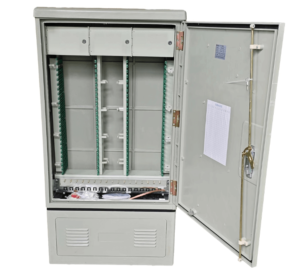
When using primary splitting, each port of the fiber distribution box is connected to a household and corresponds one-to-one with the port of the distribution optical exchange. Each household corresponds to a port of the distribution optical exchange.
Therefore, the capacity of the distribution optical frame is the maximum number of users that the ODF can cover.
The number of cores in the access section optical cable is generally a multiple of 12, and the number of ports in each row of the common unit of the ODF is also 12. Therefore, the sum of the number of cores allocated to each fiber distribution box in each corridor (or every 2 corridors) is also preferably a multiple of 12.
In this way, the number of cores in the access section optical cable is always greater than or equal to the number of households covered. As shown in the figure below, in a 20-story residential building, there are 40 households in each unit, and the total number of cores in the distribution section optical cable of this unit is 48.
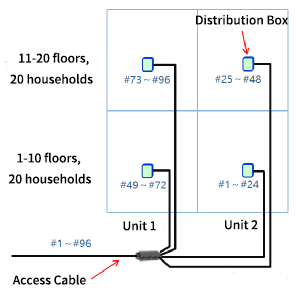
Generally speaking, in a triple play community with primary split, the number of households covered by the fiber optic cables in the introduction section is generally about 85% of the number of fiber optic cable cores in the introduction section.
The port utilization rate (number of introduced cable cores/capacity of optical intersection) of the common unit of wiring optical distribution frame is about 80%. Taken together, the coverage capacity of the wiring optical distribution frame in a triple-play cell with one-level splitting is only about 70% of its capacity. For example, the average coverage of a commonly used 576 core triple play optical fiber exchange is about 403 households.
In both national and international standards, the fiber access network is built by the developer, and the national standard only requires the construction of FTTH, but does not propose the needs of indoor distribution services.
Therefore, the capacity of the triple play integration optical exchange only considers the needs of broadband services.
Scene Using Secondary Splitting
For most cities, the two counter standard scenarios are only a minority after all. In most scenarios, ODN adopts secondary splitting.
In areas where secondary splitting is used, the access capacity of each fiber distribution box is determined by the splitter port installed inside it. The splitter mainly uses three splitting ratios: 1:4, 1:8 and 1:16. The urban area mainly uses 1:8 splitters. Each fiber splitter box is generally equipped with 2 cores (1 main and 1 backup).
There are often multiple (usually 2) operators covering the same area. Each operator builds a fiber access network according to a certain wiring ratio (number of ports built/number of households covered). The wiring ratio is generally set at around 50%, which varies slightly from operator to operator.
For example, in a 20-story residential building in the above example, when the wiring ratio is 50% to 70%, the ODN construction plan is as follows.
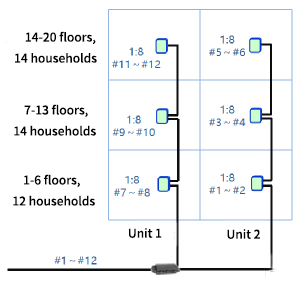
In the scenario where ODN uses secondary splitting, since the optical fiber access network is built by the operator, in order to reduce duplication of construction, the wiring optical distribution frame often also takes into account the use of data dedicated lines and wireless indoor distribution.
The fiber core requirements for data dedicated lines and wireless indoor distribution in different scenarios are also quite different. The number of users that can be covered by the 576 cores wiring optical distribution frame commonly used in secondary splitting (the port utilization rate of the wiring optical exchange is estimated at 80%) is estimated as follows.
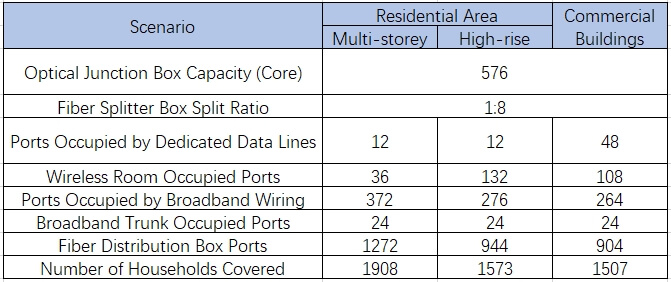
It can be seen that a 576 cores distribution optical frame can generally cover 1,500 to 2,000 households, or a commercial building of 150,000 square meters (each household is converted into 100 square meters, and 6 cores are required for every 10,000 square meters of indoor space).
Conclusion and Recommendations
When using primary splitting, the coverage capacity of the wiring optical distribution frame is significantly smaller than that of the secondary splitting. Therefore, in the two national standard scenario, if the wiring optical cross-connection frame is used as the demarcation point, the wiring optical cross connection frame should try to use a capacity of 576 cores or more.
When using secondary splitting, the coverage capacity of the wiring optical distribution frame is stronger, and communities with fewer users or commercial buildings with smaller building areas can also use 288-core optical cross-connections.
Bonelinks can not only provide you with complete passive ODN products, but also provide ODF, racks and fiber jumpers of different sizes, lengths and thicknesses to meet link design requirements according to the actual situation of the project. If you need technical support, please contact us to get support from engineers.