

In recent years, G654E fiber has been increasingly used in new trunk cable lines. For a long time, G652D fiber has been the main fiber in trunk lines, and G655 fiber has only been partially used in cable lines built around 2003.
One of the main reasons for using G654E fiber in current trunk lines is that the transmission capacity of G652D fiber is difficult to meet the needs of business development due to the Shannon limit. However, is the transmission capacity of G654E fiber greater than that of G652D fiber?
In the article “How the Shannon Limit Affects Fiber Capacity”, it is mentioned that the communication capacity C of an optical fiber is determined by the bandwidth B of the fiber and the spectral efficiency, and the following is an analysis of the size of the communication capacity of G654E versus G652D optical fibers in terms of these two aspects.
Bandwidth Of The Fiber B
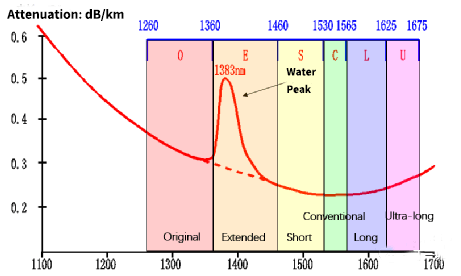
The common wavelength range of singlemode fibers is usually divided into six bands, O, E, S, C, L, and U, as shown below. Long-haul routes mainly use the C band of which the attenuation is lower.
The capacity of ultra 100G WDM system is usually increased by two methods: increasing the modulation order and increasing the baud rate of a single channel.
Increasing the modulation order is often difficult to meet the requirements of the trunk line of more than 1000 kilometers without power relaying, and raising the baud rate of a single channel is relatively easy to realize. At present, the 80×200G and 80×400G in the trunk system mainly adopt the method of raising the baud rate of single channel.
The increase in baud rate is required to enhance the channel spacing, thus using a larger fiber bandwidth, the current trunk line used in the 80 × 400G system has been extended to the L band.
Fiber in the S band attenuation, dispersion, macro-bending performance is better than the U band, and the bandwidth exceeds the L band, in the future, N × 800G and above capacity of the WDM system is likely to further expand to the S band.
The bandwidth and typical attenuation values of optical fibers in different bands are shown in the table below.
 .
.
However, the cut-off wavelength of G654E fiber is usually around 1520nm (the national standard requirement is “≤1530nm”), and does not support the extended use of the S-band, so the available bandwidth of the G652D fiber is about 75% higher than that of the G654E for the trunk level applications.
Spectral Efficiency SE
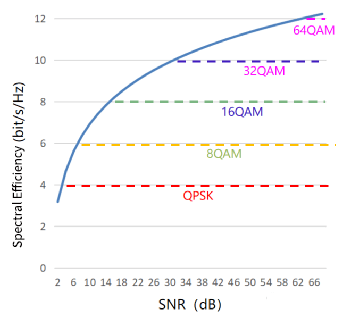
As analyzed in the article “How the Shannon Limit Affects Fiber Optic Capacity”, the improvement of fiber optic spectral efficiency SE needs to be achieved through multi-order modulation, and higher order modulation requires higher SNR, for example, if the modulation method is upgraded from QPSK to 8QAM, the SNR should be upgraded by at least 4dB; and if the modulation method is upgraded from 8QAM to 16QAM, the SNR should be upgraded by at least 8dB, as shown in the figure below.
In the article “What is G654E fiber? What scenarios is it suitable for”, it is mentioned that G654E fiber can improve the OSNR of the multiplexing section by about 3dB compared with G652D fiber.
However, due to the fiber optic link in the ODF into the end to the equipment pigtail between the existence of G654E and G652D mixing (the current equipment pigtail is still using G652D fiber), and a multiplexing section within the optical amplification segment attenuation is not balanced, the actual trunk network, multiplexing section using G654E fiber OSNR than using G652D fiber to be larger than the G652D fiber 2.0 to 3.0dB.
Remarks:
A multiplexing segment is a transmission segment between adjacent optical termination stations, between optical splitter stations, and between optical termination stations and adjacent optical splitter stations that constitutes a transmission segment used for electrical relaying.
Optical amplifier segment means a transmission segment between adjacent optical amplifier stations, between an optical terminal station and an adjacent optical amplifier station, and between an optical split station and an adjacent optical amplifier station, constituting a transmission segment used to extend the length of the non-electrical relay.
The effect of OSNR on SNR can be reflected by the formula, where Rs is the baud rate in GBaud.
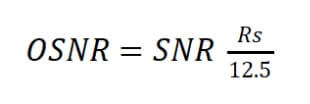
For example, for an 80×200G system with a baud rate of 64 GBaud and PM-QPSK modulation, when the OSNR is increased by 3 dB, the SNR is only increased by 0.59 dB.
As can be seen in the figure, this increase in the SNR has a negligible effect on the spectral efficiency.
Effect of OSNR On Transmission Distance
Although the increase in OSNR does not increase the capacity of the system, the effect on the transmission distance of the system is obvious.
When the OSNR of the multiplexing segment using G654E fiber and the multiplexing segment using G652D fiber are the same, the number of optical amplifiers used in the multiplexing segment using G654E fiber can be significantly increased, as can be seen from the formula for calculating the OSNR (shown in the following figure).
An increase in the number of optical amplifiers in a multiplexing segment means an increase in the number of spanning segments and the transmission distance.

Using the equation in the above figure, it is also possible to calculate the multiple increase in transmission distance when the OSNR of the multiplexed segment is increased, as shown below.
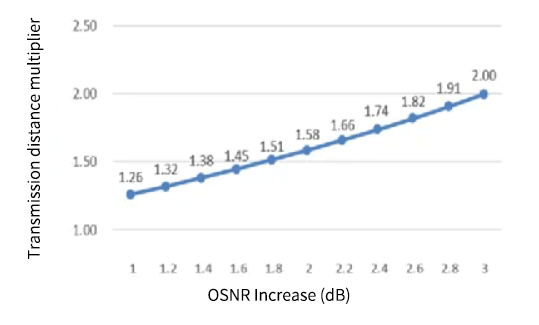
From the above figure, it can be seen that when the OSNR of the multiplexing segment is increased by 2.0 dB to 3.0 dB, the transmission distance of the multiplexing segment can be increased by a factor of 1.58 to 2.0, which is basically in line with the comparative application comparisons of the G654E and G652D optical fibers in the existing network.
In the fiber optic cable section where a new optical amplifier station is required, if the system is not sensitive to the transmission distance of the multiplexing section, the use of G654E fiber can increase the transmission distance of the optical amplifier section by 10.0km to 15.0km, thus reducing the construction cost of the optical amplifier station.
Put At The End
Due to the limitation of the cut-off wavelength, the wavelength band used in G654E optical fiber cannot be further expanded to the S-band at this stage, which also limits the capacity of G654E. In order to solve this contradiction, the cutoff wavelength of G654E fiber has a tendency to decrease gradually.
In the C+L band system, the system capacity supported by G654E fiber and G652D fiber is equivalent, except that the maximum powerless relay distance is longer with G654E fiber.
When a multiplexing section can open N×800G system by using G654E fiber, it can definitely open N×400G system by using G652D fiber.
Overall, the transmission capacity of G654E fiber is lower than that of G652D.
In the bands supported by G654E fiber, for the same WDM system, G654E fiber can increase the maximum powerless relay distance of the system by 50% to 100% compared to G652D, which may be the significance of the existence of G654E fiber.