
In recent years, in some of the long-distance trunk lines began to use a new type of G.654E fiber, and achieved better results. The development of communications technology is changing rapidly, fiber optic communications in a single-core capacity also doubled every 3 to 5 years in the rapid growth of speed, but the main types of optical fibers for communications and the main transmission index of optical fibers for many years without major changes, for example, the current widespread use of G.652D optical fiber, the use of which has been nearly 20 years of history.
So, what is G.654E fiber and will G.654E fiber replace the traditional G.652D fiber?
History of G.654 Fiber
In the mid-1980s, in order to meet the demand for long-distance communication in submarine cables, a single-mode fiber with a pure quartz core was developed for use at 1550 nm wavelength, and its attenuation near that wavelength was more than 10% lower than that of G.652 fiber. This fiber was defined as G.654 fiber, which was then called “1550nm wavelength attenuation of the smallest single-mode fiber”.
In the 1990s, WDM technology began to be used in the submarine optical communication system, WDM technology enables a fiber to simultaneously transmit dozens or even hundreds of optical channels, and with the use of fiber amplifiers, high-power multi-wavelength optical signals are coupled into a single optical fiber, aggregated in a very small interface, the optical fiber began to show nonlinear characteristics.
Due to the nonlinear effect of the fiber, when the incoming optical power exceeds a certain value, the transmission performance of the system will gradually decline with the increase of the incoming optical power.

The nonlinear effect of the fiber and the optical power density of the fiber core is related to the optical power density of the fiber core, in the incoming optical power is unchanged, by increasing the effective area of the fiber, reducing the optical power density of the core, can reduce the nonlinear effect on the transmission performance. Therefore, G.654 optical fiber began to increase the effective area on the article.
The increase in the effective area of the fiber will lead to an increase in the cut-off wavelength, but the increase in the cut-off wavelength must be controlled so as not to affect the use of optical fiber in the C-band (1530nm ~ 1565nm); therefore, the cut-off wavelength of the G.654 fiber is set to 1530nm. 2000, the ITU in the revision of the G.654 optical fiber standard, will be modified to the name of the “Cut-off wavelength shifted single mode fiber”.
By now, G.654 fiber has two characteristics in low attenuation and large effective area. After that, G.654 optical fiber used for submarine cable communication is also mainly optimized around the attenuation and effective area, and gradually developed into four subcategories of G654A/G654B/G654C/G654D.
Characteristics of G.654E Optical Fiber
Land trunk transmission lines in the fiber type to G.652D-based, with the WDM system single-carrier rate of more than 100G, the fiber’s nonlinear effect on the transmission performance of the impact of the more serious, the researchers naturally want to G.654 fiber transplanted to land long-distance trunk transmission system to use.
Relative to submarine use, terrestrial use of G.654 optical fiber macro-bend loss requirements are much more stringent (macro-bend loss and G.652D consistent), while the effective area of the fiber, attenuation indicators than the submarine with the requirements of a wide range, so that the formation of the standard G.654E fiber. G.654 optical fiber of the various subclasses of the main transmission indexes of the differences in the table below.

Advantages and disadvantages of G.654E over G.652D
(1) G.654E fiber advantages
Single-carrier ultra 100G WDM system, with the increase of single-carrier rate, the higher the OSNR tolerance requirements of the system, OSNR is related to the optical power of the incoming fiber, the attenuation of the optical discharge section, etc. G.654E fiber’s large effective area, low attenuation characteristics, can effectively improve the OSNR.

The effective area of G.654E fiber is mainly divided into two types, 110 um2 (A110) and 130 um2 (A130), and both A110 and A130 fibers are used for the trunk lines constructed between 2015 and 2018, while only A130 fibers are used for the trunk lines constructed after 2018. The effective area of G.654E (A130) fiber is about 1.7 dB higher than that of G.652D ( A80) fiber by about 47%, and the optimal optical power into the fiber can be improved by about 1.7 dB with the same nonlinear effect.
Typical attenuation of G.654E fiber is about 0.02dB/km lower than that of G.652D fiber, and the attenuation of an 80km-long optical amplification segment using G.654E fiber is about 1.6dB lower than that of G.652D fiber.
Since the location of the optical release station in the terrestrial trunk transmission system is often determined, the enhancement of the incoming optical power and the reduction of the fiber attenuation do not significantly reduce the number of optical release stations. Under the condition that the setting of optical amplification stations remains basically unchanged, the OSNR of G.654E fiber can be improved by about 3dB compared with G.652 fiber.
(2) Disadvantages of G.654E optical fiber
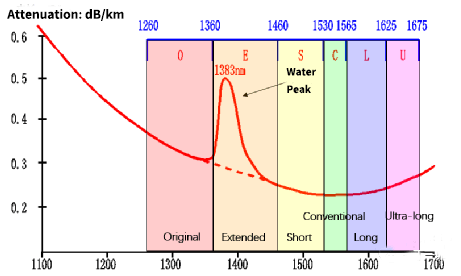
The cutoff wavelength of G.654E fiber is 1530nm, which limits the use of G.654E fiber to wavelengths below 1530nm. Currently, the transmission system of single optical module super 100G in MAN mostly works near 1310nm wavelength (O-band), such as the core layer and aggregation layer system of 5G backhaul, so G.654E fiber is not suitable for use in MAN.
The market size of G.654E fiber is far from being comparable to that of G.652D fiber, which has led to the high price of G.654E fiber. Currently, the unit price of G.654E bare fiber is about 10 times that of G.652D fiber.
In Summary
Currently, according to incomplete statistics, the operators in the inter-provincial and intra-provincial trunk line construction of optical cable, the use of G.654E fiber optical cable length of nearly 15,000 kilometers, the use of the effect of the analysis with the above basically match. This is sufficient to show the necessity of G.654E fiber in the interprovincial trunk lines.
Compared with the interprovincial trunk lines, the single carrier rate of the provincial trunk lines is usually lower, the number of optical amplification segments in the multiplexing section is much lower, and the system’s tolerance requirements for OSNR are correspondingly lower, so the necessity of using G.654E optical fiber in the provincial trunk lines is not high, and it is recommended that G.652D low-loss optical fiber be used (the unit price of the bare fiber is about 1.5-2.0 times that of the ordinary G.652D).
In metropolitan area networks, some optical transmission systems use wavelengths within the cut-off wavelength range of G.654E fiber, so G.654E fiber is not suitable for use in metropolitan transmission.